Part 2 | The Woman They Called Trash: The Founding Mother’s Reckoning
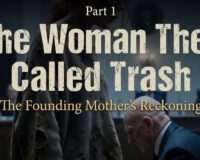
She stood before the marble pillars and crystal chandeliers like a ghost from another lifetime — hair wild, face streaked with dried mud, clothes hanging in rags. The woman in the cream suit laughed with perfect teeth and called her trash. But the dirt on her skin was not shame. It was the soil from which an entire empire had grown. And on this day, the empire remembered its mother.
The Arrogance of Polished Marble
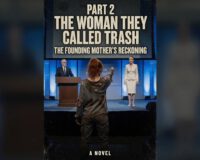
The grand hall breathed with the weight of centuries — heavy chandeliers dripping light like frozen tears, rows of suited alumni and faculty watching from velvet seats. Dr. Victoria Lang stood at the podium, cream suit sharp as a blade, voice ringing with practiced authority. “Our alumni are billionaires, not beggars,” she declared, gesturing dismissively at the figure before her. Security officers shifted uncomfortably behind her, hands ready.
To Victoria, the red-haired woman was an eyesore — a living contradiction in the temple of success she had spent years curating. The woman’s torn sweater carried the scent of rain-soaked earth and forgotten roads. Her boots were caked in the same mud that now dusted her cheeks and neck. Victoria felt a surge of righteous disgust. This was not the image she had fought to project. Universities produced leaders, not wanderers. She raised her hand. “Security, clear this trash.”
In that single command lived the quiet rot of forgotten origins — the human tendency to erase the hands that once built the very floors we walk upon.
The Dirt That Carried a Fortune
The red-haired woman — Eleanor Voss — did not flinch. She had walked through decades of loneliness to reach this moment. Years ago, as a young idealist with nothing but fire in her veins, she had poured her entire inheritance, her youth, and her quiet sacrifices into founding this university. While others chased fame, she had labored in silence, believing knowledge should lift the forgotten.
Now she lifted a simple tablet. The massive screen behind the judges flickered to life, bathing the hall in cold blue light. A single document glowed: Founding Donation — $18,114,126,339. Her signature, faded but unmistakable, sat at the bottom. The words beneath it spoke of a promise long broken — a legacy twisted into something unrecognizable.
Eleanor’s voice, steady and low, cut through the stunned silence. “I didn’t come to beg. I came to foreclose.”
The hall seemed to inhale sharply. Victoria’s perfect composure cracked. A senior board member — the bald man in the dark suit who had once shaken her hand at galas — slowly sank to his knees before Eleanor, head bowed in recognition and regret.
The Weight of Twenty Years
Eleanor looked down at the kneeling man, then back at Victoria. The mud on her face was no longer dirt — it had become a crown. Every crack in her sweater told a story of nights spent alone, of choices made in the name of something greater than herself. She had given everything so others could rise, only to watch her creation become a gated kingdom that turned away the very souls it was meant to serve.
“You owe me twenty years of interest,” she said softly. Not with rage, but with the exhausted wisdom of someone who had carried the weight of an entire institution on her back while the world forgot her name.
Victoria gripped the podium, knuckles white. “This is impossible,” she whispered, the words dissolving into the vastness of the hall. The audience, once silent, began to murmur. The illusion of power — so carefully constructed — was crumbling under the simple truth of origins.
The Reckoning No One Saw Coming
In that grand space of polished wood and echoing voices, time folded in on itself. The woman in rags had never sought revenge. She had only come to remind them that every empire rests on unseen shoulders. The dirt on her skin was the price of creation. The rags were the uniform of sacrifice. And the tablet in her hands was proof that true power does not announce itself with noise — it waits, patient as earth itself, until the moment the proud must finally kneel.
Life Lesson Never mistake polished appearances for true worth. The person you dismiss as unworthy may be the very foundation upon which your world stands. Humility is the soil from which lasting legacies grow.
Philosophical Meaning Modern society worships the visible — the titles, the suits, the billionaires. Yet the deepest truths are often carried by those we refuse to see. Eleanor’s story reminds us that every great institution, every empire of knowledge or wealth, began with someone willing to stand in the mud and build. Arrogance is the delusion that we are self-made. Redemption arrives when we remember the hands that lifted us — and the quiet courage it takes to return, not in triumph, but in quiet, unyielding truth.
Final Emotional Conclusion As the chandeliers continued to glow above them, Eleanor turned away from the kneeling man and the stunned official. The mud on her face caught the light like ancient war paint. She had not come to destroy. She had come to restore. And in the heavy silence that followed, the university — for the first time in decades — felt the weight of its own beginning.
Some foundations are made of marble. The strongest are made of mud, memory, and the quiet refusal to disappear.